
We often view aging through the lens of what we can see in the mirror. But the most sophisticated anti-aging tool you own isn't sitting on your vanity—it is literally at your fingertips.
Your hands are not just tools for working or touching; they are deeply connected to your brain. The way you move them, use them, and even how you hold tension in them has a direct impact on your focus, your body, and over time, how you carry yourself—including your face.
This is what I call Neuro-Maintenance—taking care of your nervous system through simple, intentional movement.
1. Why the Hands Matter So Much
Each hand is a highly specialized structure composed of 27 bones, over 30 muscles, and a dense network of nerves and connective tissue.
This complexity allows for incredible fine motor control, but it requires constant, high-bandwidth communication with the brain. When movement becomes restricted or repetitive (like scrolling or typing), this communication narrows. When movement is varied and intentional, the entire neural system stays active, responsive, and precise.
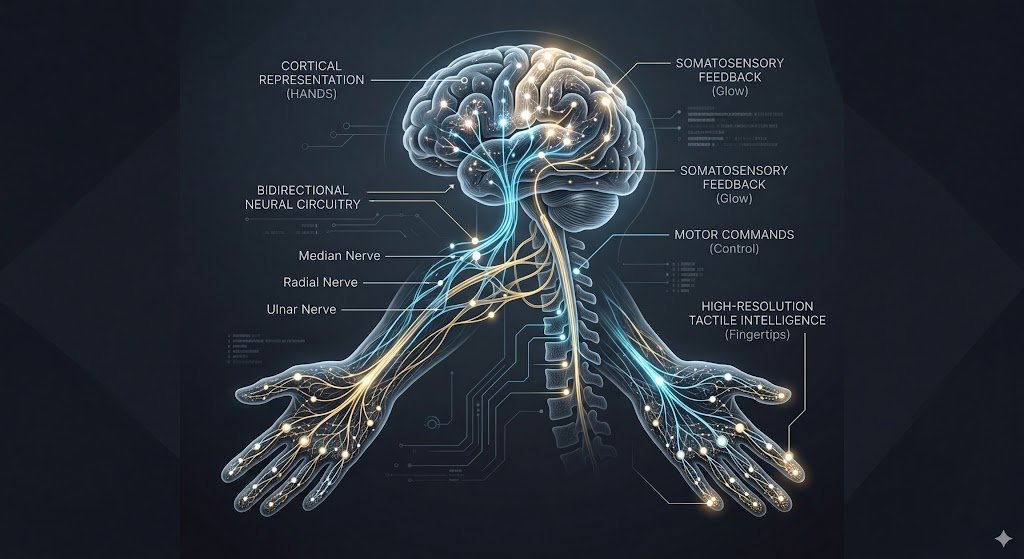
2. The Brain Map: Why Hands Are “Neural Gold”
In neurology, if we map the brain based on the "real estate" it dedicates to each body part, the hands stand out immediately. This map—known as the Cortical Homunculus—shows that the hands and fingers occupy a massive percentage of both the Motor Cortex (movement) and the Somatosensory Cortex (touch).
This reflects three key demands:
High Sensory Density: Fingertips contain a massive concentration of mechanoreceptors.
Precision Control: Fine motor tasks require continuous, high-resolution coordination.
Continuous Feedback: The brain constantly updates your internal "state" based on input from the hands.
The Rule: The more precision a body part requires, the more brain resources are dedicated to it.
3. The Neural Anchor: A Path to Focus and Regulation
Most people try to regulate their mental state through thought alone. A more efficient pathway is through controlled sensory input. Intentional hand movement engages a "sensory–motor loop" that provides Proprioceptive Feedback—your brain’s internal awareness of its own position.
The Focus Effect: Structured hand movement provides a stable point of attention, helping shift the brain away from rumination (the Default Mode Network) and toward task-oriented processing.
The Regulation Effect: Slow, controlled movement sends a signal to the nervous system to reduce unnecessary muscular tension. This helps you settle into a more grounded physiological state, which is often reflected in a softer jaw and a more relaxed brow.
4. Supporting the System: The Biological "Software"
While intentional movement provides the hardware reset, your nervous system requires specific biochemical support to maintain the "insulation" and signaling speed between your hands and your brain.
To keep this loop high-definition, we focus on three foundational nutrients:
Omega-3 Fatty Acids (DHA/EPA): These are the structural building blocks of the Myelin Sheath. Think of myelin as the "insulation" on your internal wiring; it ensures that sensory signals travel from your fingertips to your brain at maximum velocity without interference.
Magnesium Glycinate: Known as the ultimate mineral for relaxation, magnesium regulates the neuromuscular "relaxation response." It helps melt away the micro-tensions in the forearms and hands that often lead to chronic stiffness in the neck and jaw.
B-Complex (Active B6/B12): These are essential for nerve repair and maintaining the sensitivity of your tactile receptors. They ensure your hands remain a sharp, responsive interface for navigating the world.
A Simple Way to Start: The 60-Second Reset
Neuro-Maintenance doesn't require an exhaustive routine; it requires intentional consistency. You can begin shifting your internal state by integrating a simple 60-second ritual before your morning coffee or your evening skincare.
The Practice: Slowly and intentionally move your hands through their full range of motion—circling the wrists, gliding the tendons, and opening the palms. Focus entirely on the tactile sensation of the joints and the skin. No force, no strain—just smooth, controlled movement.
The Benefits: By dedicating just one minute to this practice, you are doing more than "stretching." You are:
Clearing the "Neural Noise": Providing a high-definition signal that pulls your brain out of a scattered state and into the present.
Interrupting Tension Loops: Breaking the circuit between stiff hands and a clenched jaw before it settles into your facial expression.
Priming the System: Preparing your nervous system to fully receive the benefits of your self-care products and rituals.
As your hands find ease, your mind follows. You’ll find that a regulated hand-brain connection leads to a more focused day and a deeper, more restorative night.
Final Thought: Your Hands are Your Health
Your hands are the most information-rich sensors your brain has for navigating—and regulating—your life. They are not merely tools; they are the most accessible bridge to your internal state.
When you refine the way your hands move and sense, you are directly upgrading how your brain organizes attention, coordination, and control. This is the ultimate longevity practice—one that is always within your reach.
Movement is the medicine; your hands are the dose.